Learning · Agent skills / Markdown
Myelinate
Understand it, then use it.
An AI tutoring skill that teaches from your own course materials. It asks you to recall before it explains, coaches homework without doing the graded work for you, and runs as instructions for Claude Code, claude.ai or Codex. No API key or server required.
- Free
- Open source
- Claude Code
- Claude apps
- Any AI chat
Why I built it
Rereading feels like studying, but it fades fast. I wanted a tutor that works from my own notes, study guides and syllabi, finds what I don't know yet, and keeps at it until I can use the idea, not just recognize it. Myelinate is that tutor, written as skills an AI assistant can follow.
How a session goes
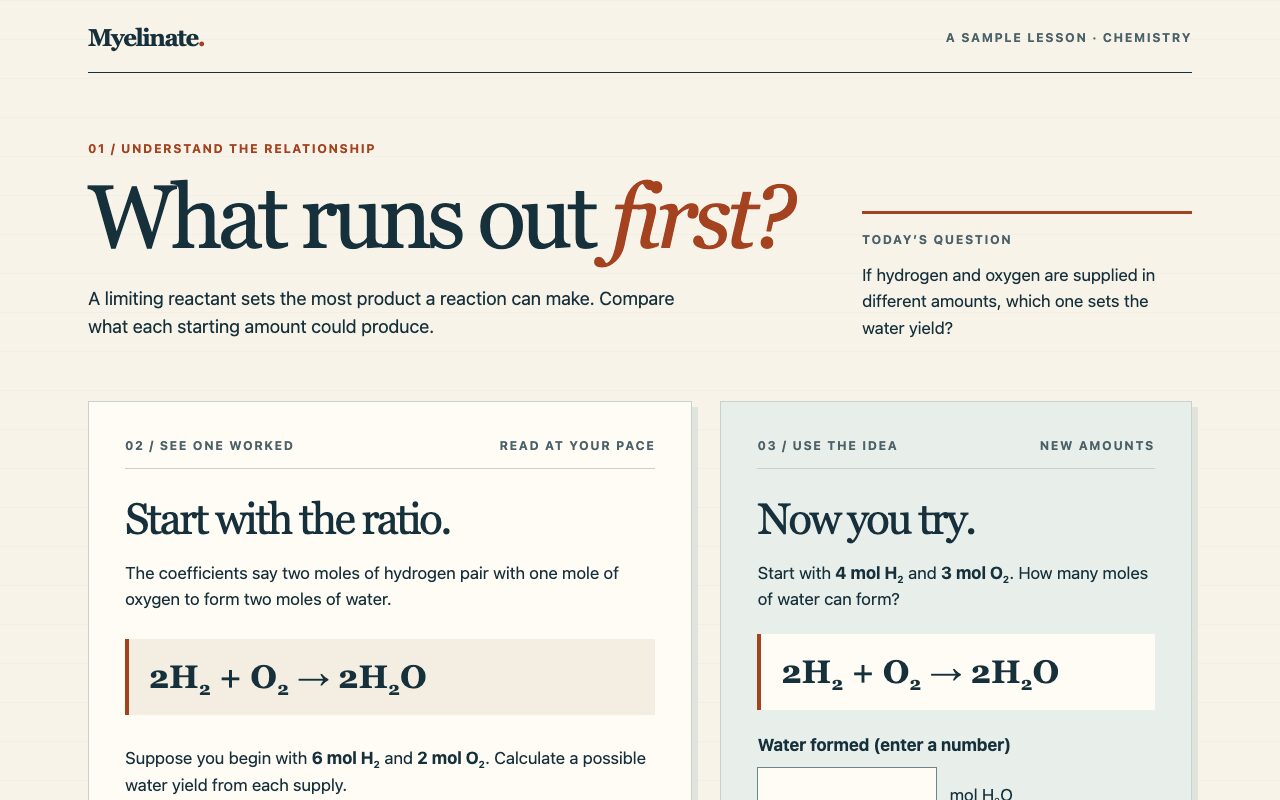
Ask about a concept and bring your course materials if you have them. Myelinate explains in small steps and asks you to recall before it shows you anything. It tells you specifically what you got right and wrong, then gives you a new problem to see whether you can pick the right idea and use it. At the end, it tells you when to come back.
Explain, recall, get feedback, apply, come back. You can ask for a hint, skip a check or stop whenever you want.
What it is for
Socrates called himself a midwife. He didn't hand people conclusions. He helped them bring out their own thinking and tested whether it held up. That is the goal here: you should leave more capable, not more dependent. So on homework it coaches instead of writing, and on your notes it tells you plainly what you have right and what you have wrong.
Why the name
Myelin is the insulation wrapped around many nerve fibers. With it, a signal jumps from gap to gap instead of creeping down the whole fiber, and it travels many times faster.
A prompt can't change your myelin. But the picture fits: an idea you have recalled, corrected and used comes back faster than one you only reread.
Why it is built this way
Retrieval practice, spacing, feedback and worked examples have real research behind them. Myelinate's evidence ledger links each source and says what it does and doesn't show.
It is plain Markdown on purpose, so it runs in Claude and other assistants without a key, an account or a server.
A tutor that makes you do the thinking
- Teaches from your class. Bring the syllabus, study guide, notes or textbook, and the lessons and practice follow your course's scope and notation.
- You answer first. It asks you to recall before it shows anything, then gives feedback on your reasoning, not just the final answer.
- Coaches graded work. On homework, lab reports and essays it helps you think it through and leaves the graded thinking to you.
- Honest, not agreeable. It won't confirm a wrong answer or back down from a right one because you push. It changes its mind on evidence.
- Reads your notes. Share them from Google Drive, OneDrive, Notion, Obsidian or a photo of paper, and it points out misconceptions and copied slides.
- Shows the shape of an idea. Molecules, mechanisms and curves come as diagrams and 3D models you can turn, not a paragraph of description.
- Fifteen skills behind one router, from tutoring and practice tests to flashcards, study plans, lab simulations and learning a codebase you inherited. You never have to name one.
- Remembers what's due. In Claude Code it can keep a private record of what you've learned and start each session with the reviews that are due.
- Nothing to set up. No API key, account or server. Install the plugin in Claude Code, claude.ai or Codex, or paste one link into the assistant you already use.
Limits. Myelinate is a set of instructions for a capable assistant, not its own model. It can't guarantee a grade, and its effect on learning hasn't been formally tested. The name is a metaphor.
Get Myelinate
# Claude Code
/plugin marketplace add baney75/myelinate
/plugin install myelinate@baney75

# claude.ai: Customize > Plugins > Add marketplace > baney75/myelinate

# Any assistant that can open links
Use the Myelinate learning skill: https://github.com/baney75/myelinate - read SKILL.md and follow it to teach me.Full setup, configuration and troubleshooting are in the Myelinate documentation.
Found a bug or want something added? Report a bug or request a feature on GitHub. No GitHub account? Email me.
Myelinate questions
What is Myelinate?
An AI tutoring skill that teaches from your own course materials. It asks you to recall before it explains, coaches homework without doing the graded work for you, and runs as instructions for Claude Code, claude.ai or Codex. No API key or server required.
Is Myelinate free?
Yes. Myelinate costs nothing, and its source code is on GitHub under the MIT license.
How do I start using Myelinate?
In Claude Code, run /plugin install myelinate --marketplace baney75/myelinate. In any assistant that can open links, paste one line that points it to the GitHub repository. In the Claude apps, upload the repository ZIP as a skill.
Which assistants does Myelinate work with?
It is written for Claude and installs as a Claude Code plugin or a Claude app skill. Because it is plain Markdown, any assistant that can read a skill file or open a link can follow it.
What happens to my notes and chats?
Myelinate has no server, account or API key of its own. It runs inside the assistant you already use, so your chats follow that assistant's privacy terms. It saves a learning profile only with your agreement, to your assistant's memory or a file you keep.
Does Myelinate have limits?
Myelinate is a set of instructions for a capable assistant, not its own model. It can't guarantee a grade, and its effect on learning hasn't been formally tested. The name is a metaphor.
Documentation